




Skin Barrier Science: Dry vs. Dehydrated Diagnosis

BlissedSkin Science Team
Skincare Science Experts
Quick Answer
The clinical distinction between dry and dehydrated skin lies in the specific type of deficiency you are experiencing. Dry skin (Xerosis) is a genetic condition characterized by a severe lack of intercellular lipids like Ceramides, while dehydrated skin is a temporary state of water depletion within the stratum corneum linked to Natural Moisturizing Factor (NMF) deficits (ISDIN, 2025). Understanding this prevents the “wicking effect” and safely ensures structural barrier integrity.
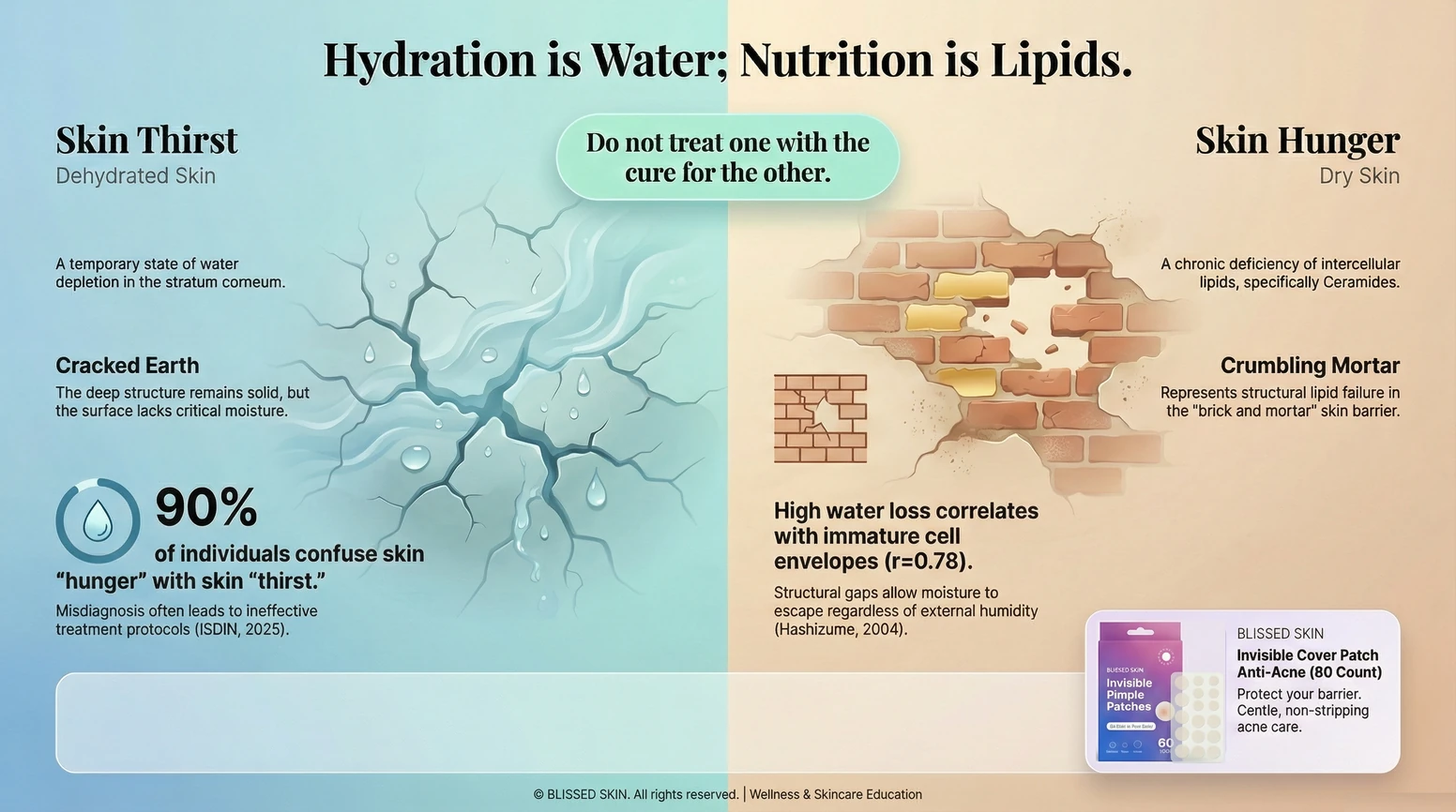
Source: ISDIN (2025). How To Build a Skincare Routine for Dry, Dehydrated Skin. ISDIN Clinical Content.
Beyond “Tight Skin”: Understanding Structural Deficiencies
Do you constantly feel like your skin is tight, no matter how many heavy creams you apply? To accurately diagnose your skin’s health, we have to look far past that superficial sensation of tightness.
Think of your skin barrier as a brick-and-mortar structure. The skin cells (corneocytes) act as the bricks, while a complex matrix of lipids forms the mortar holding everything securely together. According to 2025 clinical evidence, when this system breaks down, it manifests in two entirely different biological paths: dehydration (a temporary lack of water inside the cells) and dryness (a chronic lack of the lipid “cement”) (ISDIN, 2025).
Treating these two conditions as if they were exactly the same will only frustrate you—and it often makes the problem worse. Slathering heavy oils on dehydrated skin creates an occlusive seal, but it does absolutely nothing to quench the cellular thirst beneath. Conversely, applying lightweight, water-based gels to truly dry skin leads to immediate evaporation, because there are no lipids present to trap that moisture. This relentless evaporation is called Transepidermal Water Loss (TEWL), and it is the ultimate metric dermatologists use to measure barrier damage.
The Biology of Dry Skin: The Lipid Cement Deficit
Dry skin, clinically known as Xerosis, is fundamentally defined by a broken lipid barrier. Fundamental research reveals that your barrier’s strength relies heavily on a precise molecular ratio of ceramides, cholesterol, and free fatty acids—specifically, a 1:1:1 molar ratio (van Smeden et al., 2014).
If you have a naturally dry skin type, the carbon chains of your ceramides are noticeably shorter, which physically destabilizes your skin’s architecture. When these vital lipid chains shrink or disappear altogether, the protective matrix shifts from a strong, dense “gel” into a chaotic, disorganized “fluid” state. This microscopic chaos opens tiny gaps, allowing vital moisture to escape into the air and inviting external irritants straight in. Unlike temporary dehydration, this is usually a genetic predisposition where your sebaceous glands simply do not produce enough oil to maintain a healthy surface.
Corneocyte Maturation Mechanisms
It isn’t just about the lipids; the maturity of the actual skin cells is equally critical. Groundbreaking research has proven that dry skin consistently suffers from “aberrant maturation” of its corneocytes (Hashizume, 2004).
In a healthy barrier, the outer shell of the cell forms perfectly through protein cross-linking. In dry, xerotic skin, this process is stunted. Researchers using specialized staining techniques have found that fragile, immature cells regularly become trapped in the upper layers of the skin. This immaturity directly correlates with massive water loss (a high TEWL correlation of r=0.78), meaning your cells physically cannot hold onto water, no matter how humid the environment is (Hashizume, 2004). The result? Visible flaking, a rough texture, and an inability to shed dead skin smoothly.
The Pathophysiology of Dehydrated Skin: The NMF Factor
Here is the twist: you can absolutely have a perfectly intact lipid barrier and still suffer from severely dehydrated skin.
Dehydration is primarily caused by a sharp drop in your Natural Moisturizing Factor (NMF). The NMF is a biological cocktail of amino acids, urea, and lactates that acts like a microscopic sponge inside the cell, violently attracting and holding onto water molecules. When your NMF levels plummet—often due to aggressive foaming cleansers, harsh weather, or natural aging—your cells shrink and lose their plump turgidity.
As these cells deflate, they create micro-fissures across your skin’s surface, leaving it feeling brittle and highlighting fine lines. Clinical data proves that when the water content in your outer layer drops below 10%, your skin loses its mechanical flexibility entirely, resulting in a “cracked” appearance that many people easily mistake for permanent, premature aging (ISDIN, 2025).
Differential Therapy: Clinical Protocols
Because these issues are biologically distinct, correcting them requires opposite strategies. A generic, “one-size-fits-all” moisturizer will not cut it. You must strategically choose either hygroscopic humectants to pull water deep into the cells, or hydrophobic occlusives to patch the gaps in your lipid cement.
| Feature | Dry Skin (Alipic) | Dehydrated Skin (Hydropenic) |
|---|---|---|
| Primary Deficiency | Intercellular Lipids (Ceramides) | Water and NMF (Urea, Amino Acids) |
| Key Symptom | Scaling, roughness, invisible pores | Tightness, fine lines, possible oiliness |
| Priority Active | Emollients/Occlusives: Shea Butter | Humectants: Hyaluronic Acid, Glycerin |
| Error Risk | Humectants alone increase TEWL | Heavy oils may cause breakouts |
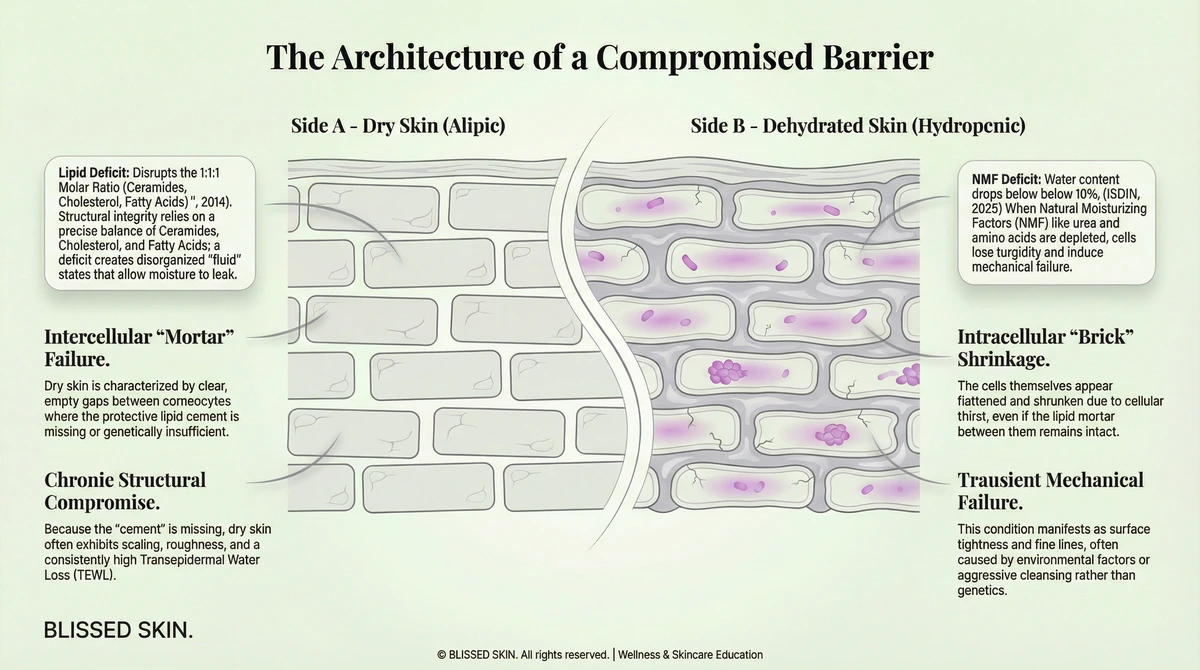
Source: van Smeden, J. et al. (2014). The important role of stratum corneum lipids for barrier function. Biochimica et Biophysica Acta.
The Role of TEWL in Barrier Assessment
Transepidermal Water Loss (TEWL) remains the absolute gold standard for judging the health of your barrier. Healthy skin naturally maintains a very low TEWL rate, but dry skin exhibits consistently high evaporation rates because of literal leaks in its lipid cement.
Interestingly, incomplete maturation of skin cells is a massive predisposing factor for overall barrier dysfunction, entirely independent of how much sebum you produce (Hashizume, 2004). This perfectly explains why extremely oily skin can still be severely dehydrated—a very common nightmare for those using harsh, stripping acne treatments. By stripping the barrier of its necessary proteins and lipids, you force the skin into an inflamed state of high evaporation, triggering the confusing “oily yet tight” phenomenon.
Conclusion: Restoring Structural Harmony
To truly heal your skin, you must address the correct biological deficit. With 90% of individuals confusing a lack of lipids with a lack of water (ISDIN, 2025), accurate diagnosis is your first step to relief. Whether you need to replenish your NMF to push your cellular water content safely above the critical 10% threshold (ISDIN, 2025), or you need to restore the exact 1:1:1 molar ratio of ceramides to rebuild your lipid mortar (van Smeden et al., 2014), targeted therapy is non-negotiable. Stop guessing and start giving your barrier exactly what it needs to thrive.
Frequently Asked Questions
Can I have oily and dehydrated skin at the same time?
Yes, absolutely. Oiliness is strictly a measure of sebum (lipid) production, whereas hydration dictates your cellular water content. Frequently, your skin will overproduce oil as a desperate attempt to compensate for extreme water loss. This vicious cycle is commonly worsened by using harsh, alcohol-based astringents that completely strip away your Natural Moisturizing Factor (NMF) (ISDIN, 2025).
Does drinking more water hydrate dry skin?
Only minimally. Any water you drink is systematically routed to your vital organs first. If your lipid barrier is structurally compromised (dry skin), the tiny amount of water that eventually reaches the surface will instantly evaporate through high TEWL. Clinically, applying topical barrier repair ingredients is drastically more effective than simply drinking water when addressing skin-specific dryness (Hashizume, 2004).
How can I tell if my corneocytes are immature?
On a clinical level, this presents as skin that visibly flakes but feels strangely “raw,” sensitive, or red when touched. This is an incredibly common side effect of overusing chemical exfoliants, which violently strip the top layers of skin before the newer, underlying cells have had the time to fully cross-link their protective protein shells (Hashizume, 2004).
What is the “Wicking Effect” in dry skin?
The wicking effect happens when you apply a powerful humectant, like pure Hyaluronic Acid, to dry skin without following up with an occlusive cream to seal it in. The humectant acts like a vacuum, pulling deep dermal water up to the surface. Without a solid lipid barrier acting as a lid, all that drawn water rapidly evaporates into the dry air, leaving your face significantly more dehydrated than when you started (ISDIN, 2025).
Are ceramides essential for every skin type?
Yes. While ceramides are absolutely critical for treating dry skin (which has a structural deficiency), they act as a fantastic preventative measure for all skin types to combat daily TEWL. Scientific research indicates that the actual chain length of the ceramide molecule determines whether your barrier stays strong and stable, or degrades into a fluid, “leaky” mess (van Smeden et al., 2014).
Why does my skin feel tighter in winter?
Cold, winter air holds very little moisture. This low environmental humidity dramatically increases the concentration gradient between your hydrated skin and the dry air, severely accelerating TEWL. On top of that, freezing temperatures physically slow down the enzymatic processes your body relies on to break down filaggrin into NMF, directly reducing your skin’s biological capacity to retain water (ISDIN, 2025).
Glossary
Corneocyte — Flattened dead skin cell of the stratum corneum acting as a barrier “brick.”
Desmosome — Protein structure that bridges corneocytes; its degradation allows for desquamation.
Emollient — Lipid ingredient that fills gaps between corneocytes to smooth texture.
Filaggrin — Filamentous protein that aggregates keratin; its breakdown creates the NMF.
Humectant — Hygroscopic substance that attracts and retains water molecules within cells.
NMF — Natural Moisturizing Factor; water-soluble compounds like urea that retain moisture.
Occlusion — Physical blocking mechanism that prevents water evaporation from the skin.
TEWL — Transepidermal Water Loss; the amount of water escaping the epidermis to the atmosphere.
References
Primary Sources
- ISDIN. (2025). How To Build a Skincare Routine for Dry, Dehydrated Skin. ISDIN Clinical Content.
- Hashizume, H. (2004). “Skin aging and dry skin”. Journal of Dermatology.
- van Smeden, J. et al. (2014). “The important role of stratum corneum lipids for barrier function”. Biochimica et Biophysica Acta.
Evidence Cited
- Hashizume, H. (2004). “Skin aging and dry skin”. Journal of Dermatology. [Cited in: [1]]
- van Smeden, J. et al. (2014). “The important role of stratum corneum lipids for barrier function”. Biochimica et Biophysica Acta. [Cited in: [1]]
3 sources | 2004–2025 | Hierarchy: Clinical guidelines > Biochemical reviews > Dermatological studies.