




Circadian Skincare: Optimizing Routine Architecture

BlissedSkin Science Team
Skincare Science Experts
Quick Answer
Skin physiology strictly follows a 24-hour circadian rhythm, dictating its core functions. During daylight, your skin activates “Defense Mode” to resist UV stress. At night, it transitions into “Repair Mode,” where permeability increases by 30% and cellular mitosis hits its peak, creating the ultimate window for absorbing active ingredients (AAD, 2026).
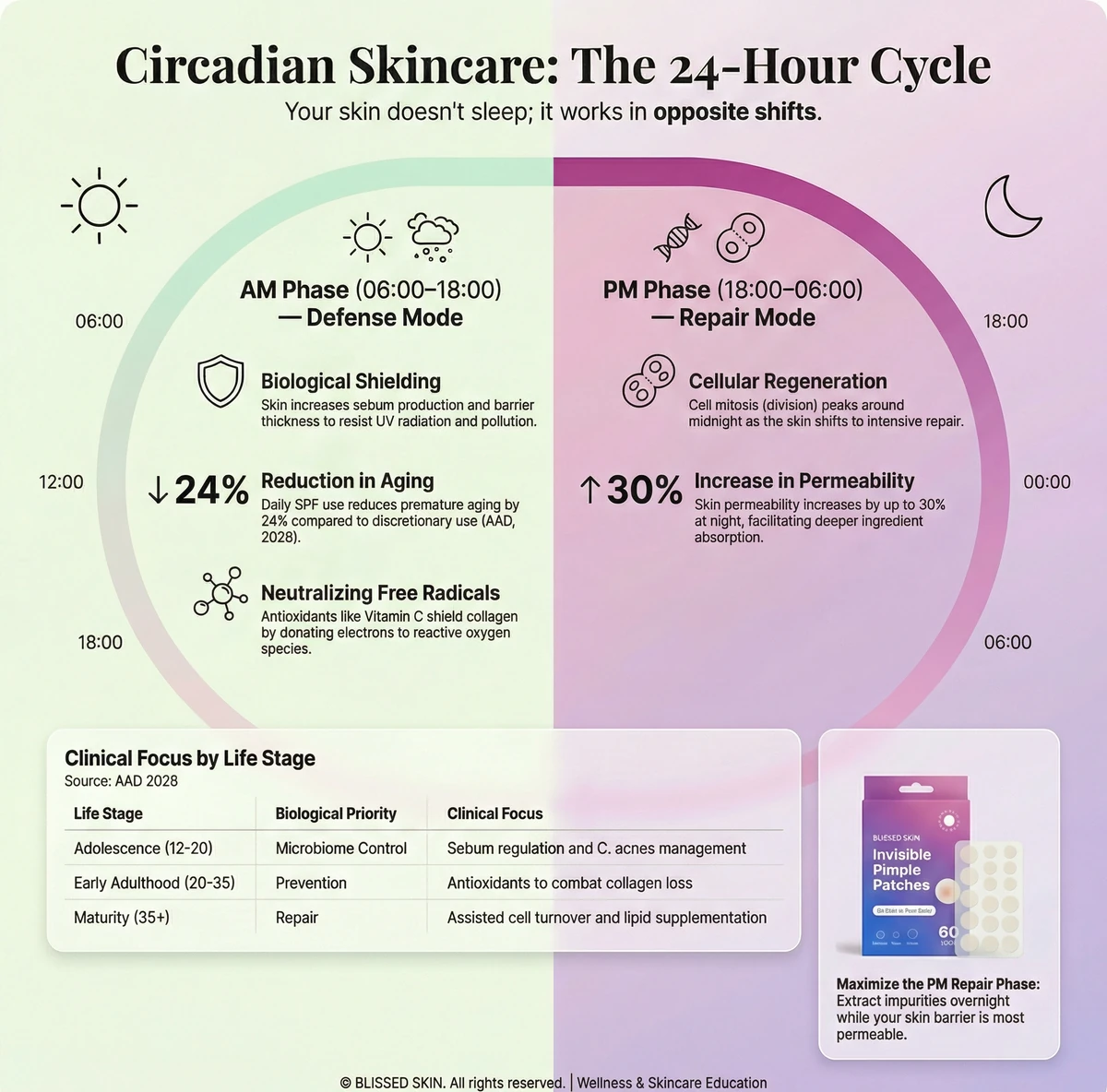
Source: AAD (2026). A dermatologist’s guide to skincare from growing up to glowing up. American Academy of Dermatology.
Circadian Synchronization: The Science Behind the Order
Modern dermatology is finally leaving behind those exhausting, maximalist “step-lists.” Instead? We are embracing intelligent, biology-aligned protocols. Why apply ten products when a few strategically timed ones work far better? (AAD, 2026).
This isn’t just about convenience; it is about mastering molecular timing. Think about it. Do we apply antioxidants in the morning just because it feels refreshing? Not exactly. We do it because the skin naturally shifts into a biological “Defense Mode” the moment the sun comes up. Simplifying your routine doesn’t mean sacrificing results. In fact, it means achieving greater precision by working with your body’s internal clocks, rather than against them (Cleveland Clinic, 2025).
Daytime Phase: Protection and Bio-Shielding
During daylight hours, your skin has one overriding priority: surviving oxidative stress. It literally pauses cellular DNA repair to save energy for immediate defense against UV rays and urban pollution. How do we best support this biological phase?
- Non-Abrasive Cleansing: The morning goal is simple. Wash away overnight metabolic waste—like sweat and oxidized sebum—without wrecking your delicate acid mantle.
- Neutralization of Free Radicals: This is exactly where Vitamin C steps up. It acts as a sacrificial electron donor, neutralizing Reactive Oxygen Species (ROS) before they can tear through your collagen structures.
- Photoprotection: Sunscreen isn’t optional; it is the ultimate non-negotiable step. Consistency pays off, as daily SPF application actively reduces premature aging by a massive 24% compared to occasional use(AAD, 2026).
Molecular Interactions: Retinol vs. Vitamin C
Have you ever felt confused about mixing potent actives? You aren’t alone. Let’s look at Retinol (Vitamin A) and pure Vitamin C (L-Ascorbic Acid). Retinol needs a pH around 5.5 to 6.0 to enzymatically convert into retinoic acid. Vitamin C, on the other hand, demands a highly acidic environment (pH < 3.5) to penetrate effectively.
Slapping them on at the same time is a recipe for disaster. You will likely neutralize the efficacy of both or trigger severe irritation through a literal “pH clash.” Chronobiology offers an elegant solution: separate them. Apply your Vitamin C in the AM to act as an antioxidant shield, and save Retinol for the PM to drive deep, uninterrupted repair (Cleveland Clinic, 2025).
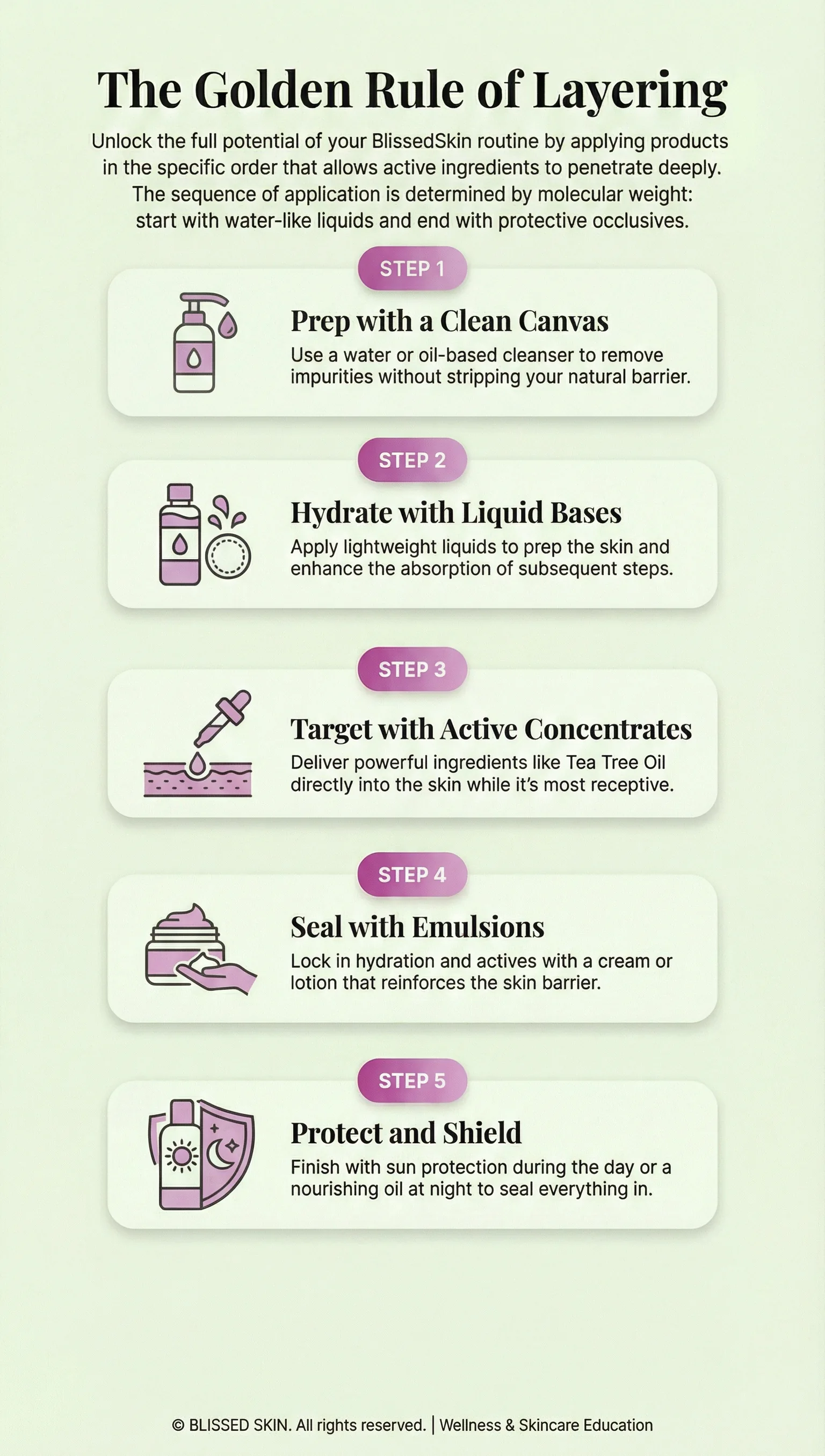
Source: Cleveland Clinic (2025). Easy Steps for a Simple Skin Care Routine. Health Essentials.
Nighttime Phase: Repair and Permeability
When the sun goes down, your skin finally gets to work. Nighttime triggers the peak of cutaneous metabolic activity. Blood flow surges to the surface, delivering crucial nutrients. However, this increased circulation also bumps up your skin’s temperature and permeability.
Therapeutic Window of Opportunity
At night, you experience a natural spike in Transepidermal Water Loss (TEWL). Combined with the relaxing of the tight junctions between your cells, your skin becomes significantly more permeable. This creates an extraordinary window for heavy-hitting actives like retinoids and peptides. Even targeted treatments, like BlissedSkin Invisible Pimple Patches, capitalize on this exact permeability window to draw out impurities safely, without damaging the surrounding barrier.
Around midnight, cellular mitosis—or cell division—reaches its absolute peak. By introducing ingredients that promote cell turnover, such as Alpha Hydroxy Acids (AHAs) or Retinol, you work in perfect synergy with this natural rhythm to maximize skin resurfacing (Cleveland Clinic, 2025).
Lifecycle Adaptation: From Growing Up to Glowing Up
Your skin’s biological priorities don’t just change from day to night; they shift drastically over the decades. A longitudinal approach to skincare is essential, as a routine must gracefully evolve as your biological focus shifts (AAD, 2026).
| Life Stage | Biological Priority | Clinical Focus |
|---|---|---|
| Adolescence (12–20) | Microbiome Control | Sebum regulation and C. acnes management |
| Early Adulthood (20–35) | Prevention | Antioxidants to combat 1% annual collagen loss |
| Maturity (35+) | Repair | Assisted cell turnover and lipid supplementation |
Conclusion: Mastering Your Skin’s Internal Clock
Aligning your skincare routine with your natural biological rhythms is the ultimate secret to maximizing efficacy while minimizing irritation. By respecting the daytime defense phase, you can actively reduce premature aging by up to 24% through consistent photoprotection (AAD, 2026). When the sun sets, capitalizing on the nighttime repair phase—when skin permeability surges by up to 30%—ensures that powerful actives penetrate deeply when your cells need them most (AAD, 2026). Whether you are combating the 1% annual collagen loss in early adulthood or protecting your delicate acid mantle, strategic timing is everything. Treat your skincare as a biological partnership, and let chronobiology do the heavy lifting.
Frequently Asked Questions
Is it necessary to wait between applying product layers?
Usually, no. You only need to wait if you are mixing actives that require vastly different pH levels. In fact, applying hydrators to damp skin can actually boost the absorption of humectants. Just be careful: avoid damp application when using strong retinoids, as enhanced penetration can lead to unwanted irritation (Cleveland Clinic, 2025).
Why does Vitamin C sometimes make my pores look dirty?
When Vitamin C oxidizes, it naturally turns a rusty, brownish-orange shade. If this oxidized liquid settles into open pores, it can look exactly like blackheads—though they are really just oxidized sebaceous filaments. A thorough evening cleanse and consistent exfoliation will easily prevent this buildup (Cleveland Clinic, 2025).
Does “Skin Cycling” have a scientific basis?
Yes, absolutely. The popular method of rotating actives—exfoliation, then retinol, followed by two recovery nights—is perfectly aligned with the biology of barrier repair. It gives subclinical inflammation enough time to fade before you reintroduce a controlled irritant, keeping your barrier resilient and functional (AAD, 2026).
When should I start using an eye cream?
The skin around your eyes is incredibly fragile, measuring just 0.5mm thick. While it isn’t strictly mandatory, starting a preventive eye cream in your 20s can help preserve elasticity in a delicate area that severely lacks natural sebaceous glands (AAD, 2026).
Is double cleansing a myth or a necessity?
It is practically a chemical necessity if your routine involves water-resistant makeup or tenacious sunscreens. Standard, gentle water-based cleansers simply cannot break down the heavy film-forming polymers found in modern SPF. That initial oil-based cleansing step is vital to properly solubilize and melt away those stubborn compounds (Cleveland Clinic, 2025).
Can I use Retinol every night?
Nighttime is definitely the optimal window for Retinol, but your frequency should depend entirely on your skin’s tolerance. The objective is to encourage cellular mitosis without pushing your barrier to the breaking point. A smart clinical approach is to start with just 2–3 nights a week, slowly increasing the frequency as your skin adapts and “retinizes” (Cleveland Clinic, 2025).
Glossary
Antioxidant — Molecule that prevents oxidation by neutralizing free radicals like ROS.
Chronobiology — The study of biological rhythms and their effect on physiology.
Photoprotection — Measures taken to defend the skin from ultraviolet radiation damage.
Acid Mantle — The thin, slightly acidic film (pH 4.5–5.5) on the skin’s surface.
pH — Potential of Hydrogen; a measure of acidity or alkalinity essential for barrier function.
Retinoid — Vitamin A derivative that normalizes cell differentiation and collagen production.
Circadian Rhythm — Physical and mental changes that follow a 24-hour cycle.
ROS — Reactive Oxygen Species; unstable molecules generated by UV that damage DNA.
References
Primary Sources
- AAD. (2026). A dermatologist’s guide to skincare from growing up to glowing up. American Academy of Dermatology.
- Cleveland Clinic. (2025). Easy Steps for a Simple Skin Care Routine.Health Essentials.
Evidence Cited
- AAD. “Acne Clinical Guidelines”. [Cited in: [1]]
- Cleveland Clinic. “Vitamin C Benefits”. [Cited in: [2]]
- Cleveland Clinic. “Retinol: What it is and how to use it”. [Cited in: [2]]
2 sources | 2025–2026 | Hierarchy: Dermatological guidelines > Health institution reviews.